-
China Local
- Eighteen Songs
- Qingming
- Hou Wu Walkabout
- Eight-sided Hall of the Huangshan Chen family
- Headquarters of the Taiping Assistant King
- Lingxia Tang Village
- Old City of Wuyi
- Seven Pillar Hall
- Shantouxia Village
- Shanxia Bao Village
- Siping Village
- Upper Tang Village
- Yanfu Monastery
- Yao Village
- Zhuge Village
- Bailu Walkabout
- Fangyan Walkabout
- Dayuan Walkabout
- Tangxi Walkabout
- Yuyuan Walkabout
- Wenlou Walkabout
- Browse Items
- Browse Exhibits
- About
- Browse Catalogue
- Documentation
- Local History in Jinhua
- Zhiyan Village
- Lu Family
- Guodong Village
- Tianning Monastery in Jinhua
- Jinhua Prefectural City God
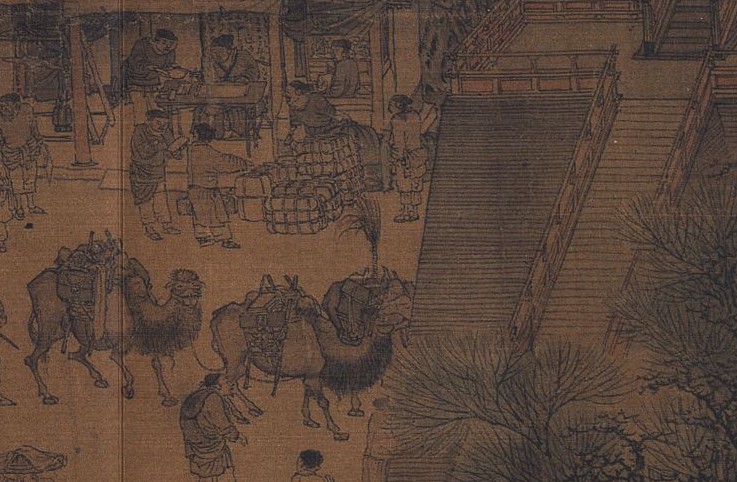
Annotation: "Here, we see a caravan of three camels passing through the city gate. The camels are carrying a variety of..."
Created by: Joy Wang
| Title: |
Annotation: "Here, we see a caravan of three camels passing through the city gate. The camels are carrying a variety of..." |
|---|
| On Canvas: |
d06f37b7-34cb-48a8-b653-943f21268ed2 |
|---|---|
| Text: |
Here, we see a caravan of three camels passing through the city gate. The camels are carrying a variety of goods, though it is rather hard to accurately identify what they have. Prior to the city gate, we also see a tax office, where officials are reviewing goods and merchants are paying taxes. It’s possible that the merchants currently present at the tax office are the ones who led the caravan.
The inclusion of camels as a method of transporting goods shows that the goods are likely coming from outside of the Song Dynasty. Specifically, Linda Cooke Johnston suggests that camels are traditionally associated with western regions, trade conducted along the silk road, and/or the Liao and Xi Xia states (161). One of the most common interpretations is that the camels represent some exchange between the Song and the Liao. Assuming that the business is indeed between the Song and the Liao, there are two main possibilities of what the camels are carrying: tribute or trade. Historically, the Song had to pay tribute to the Liao as a manner of ensuring peace and security following the Liao Invasion and the Chanyuan Treaty. It is possible that the camels were carrying the tribute, which would be silver and silk. The other option would be trade. The Song actually benefited by paying tribute, as the Liao could and would use the silver to buy Song goods. In summary, the element of camels here demonstrate the relations that existed between the Song and Liao.
Another element of note is that the caravan seems to be passing through the city gate without much hassle or security. In fact, there does not appear to be any guards at the city gate, and very few people seem to be intrigued by the presence of the camels. An interpretation of this would be that the city is thriving and relatively peaceful. The fear of threats and invasions from the North are not present as there are no security guards standing watch. This also goes along with the fact that the camels are bringing in goods, which shows amicable relationships between the Song and the surrounding states, as such trade would not be able to happen in wartime conditions. Moreover, it is significant as the Liao Invasion came dangerously close to Kaifeng. If the scroll does indeed depict Kaifeng, then this element of camels bringing it traded goods would demonstrate how conditions have truly shifted from threatening to thriving. Sources: Johnson, Linda Cooke. “THE PLACE OF ‘QINGMING SHANGHE TU’ IN THE HISTORICAL GEOGRAPHY OF SONG DYNASTY DONGJING.” Journal of Song-Yuan Studies, no. 26, 1996, pp. 145–182.
Murray, Julia K. “Water Under a Bridge: Further Thoughts on the ‘Qingming’ Scroll.” Journal of Song-Yuan Studies, no. 27, 1997, pp. 99–107. |
Files