-
China Local
- Eighteen Songs
- Qingming
- Hou Wu Walkabout
- Eight-sided Hall of the Huangshan Chen family
- Headquarters of the Taiping Assistant King
- Lingxia Tang Village
- Old City of Wuyi
- Seven Pillar Hall
- Shantouxia Village
- Shanxia Bao Village
- Siping Village
- Upper Tang Village
- Yanfu Monastery
- Yao Village
- Zhuge Village
- Bailu Walkabout
- Fangyan Walkabout
- Dayuan Walkabout
- Tangxi Walkabout
- Yuyuan Walkabout
- Wenlou Walkabout
- Browse Items
- Browse Exhibits
- About
- Browse Catalogue
- Documentation
- Local History in Jinhua
- Zhiyan Village
- Lu Family
- Guodong Village
- Tianning Monastery in Jinhua
- Jinhua Prefectural City God
Annotation: "This part of the scroll can be seen as a political and cultural message about city life’s complexity and sophistication..."
Created by: Caiseen Kelley
| Title: |
Annotation: "This part of the scroll can be seen as a political and cultural message about city life’s complexity and sophistication..." |
|---|
| On Canvas: |
d06f37b7-34cb-48a8-b653-943f21268ed2 |
|---|---|
| Text: |
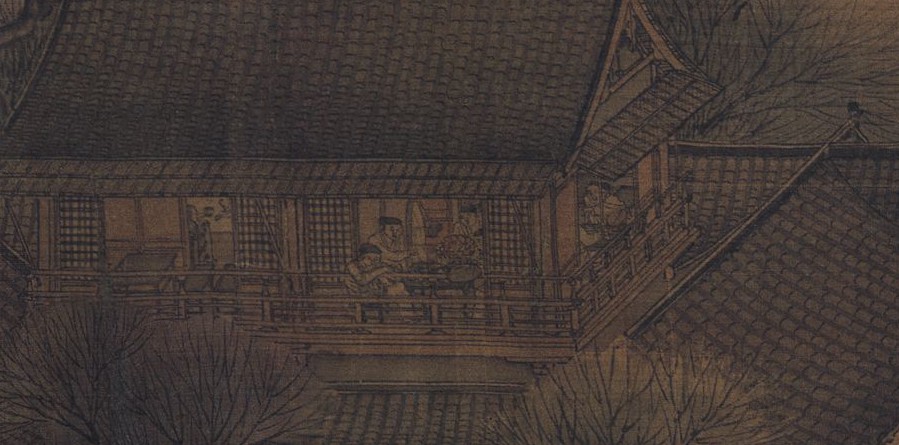
This part of the scroll can be seen as a political and cultural message about city life’s complexity and sophistication in the Song dynasty. This is understood by studying the vivid details imbued in the imagery. By pairing this specific depiction of the Branch Wine Shop with Ebrey’s “Attractions of the Capital,” we glean clues about the intricacies of Song city life and the placed value on its pleasures and conveniences. Because the city depicted here is not clearly demarcated as Professor Hansen elucidates in “Beijing Qingming Scroll”, we can read this representation as that of an “ideal city” in which “cities prospered, and their residents flourished” (Hansen 5). This is revealed through the artist’s decision to label the shop “Branch Wine Shop” which was a shop category, rather than a name that was unique to the city of Kaifeng or Hangzhou (Hansen 4). Like the scroll’s depiction, the description of the city of Hangzhou in 1235 reads both as informative but also promotional in nature. As just one of the many features of the city scene, the branch wine shop allows us a closer look at city life in the Song dynasty. The author describes the wine shop as places of ornate décor which follows with what we see in the scroll’s imagery: “The mansion-style inns are either decorated in the same way as officials’ mansions or are actually remodeled from such mansions…the luxuriant inns have prostitutes residing in them, and the wine chambers are equipped with beds” (Ebrey 180-181). The thatched walling that surrounds the balcony is distinctly more elaborate than the tavern next door. The perspective that the artist chose for the wine shop allows the viewer to peer inside and examine inside the wine shop for its distinct identifying demarcations as well as for a closer look at the people who frequent it. The author reveals that this signature “painted branch twig” allows customers to distinguish this type of wine house from ones that sell only wine. In chosing this imagery, the artist illuminates the commonality of prostitution as an accepted practice in the Song dynasty. As a result, we can see prostitution’s acceptance in the Song dynasty as both characteristic of male-dominated leisure economy but also as potential economic and social mobility for women. Despite this potential mobility, the author of “Attractions of the Capital” cautions men against being “robbed” by girls who order the most expensive delicacies. In doing so, the author’s intentions differ from that of the artist, who seeks to illustrate the complexity of the city rather than to offer guidance. Moreover, the diction the author uses to describe customers who frequent wine shops allows us to understand the depicted shop’s clientele. This is as a place where one’s vices can be fulfilled, but not a “respectful place” for “polite company” (Ebrey 180). Additionally, the author gives us clues about the patrons who are depicted upstairs in the scroll saying that one should “refrain from going upstairs if you only intend to order a few drinks and stay a short time” (Ebrey 180). The scroll shows customers sitting around a table, exemplifying the customer’s ability to take leisure time. The woman depicted leaning on the rail looks longingly in the distance, placing this as a moment in time. Ultimately, this wine shop scene serves to give the viewer a better understanding of an idealized Song dynasty city and the cultural and social practices that may have been otherwise lost to history.
|
Files