-
China Local
- Eighteen Songs
- Qingming
- Hou Wu Walkabout
- Eight-sided Hall of the Huangshan Chen family
- Headquarters of the Taiping Assistant King
- Lingxia Tang Village
- Old City of Wuyi
- Seven Pillar Hall
- Shantouxia Village
- Shanxia Bao Village
- Siping Village
- Upper Tang Village
- Yanfu Monastery
- Yao Village
- Zhuge Village
- Bailu Walkabout
- Fangyan Walkabout
- Dayuan Walkabout
- Tangxi Walkabout
- Yuyuan Walkabout
- Wenlou Walkabout
- Browse Items
- Browse Exhibits
- About
- Browse Catalogue
- Documentation
- Local History in Jinhua
- Zhiyan Village
- Lu Family
- Guodong Village
- Tianning Monastery in Jinhua
- Jinhua Prefectural City God
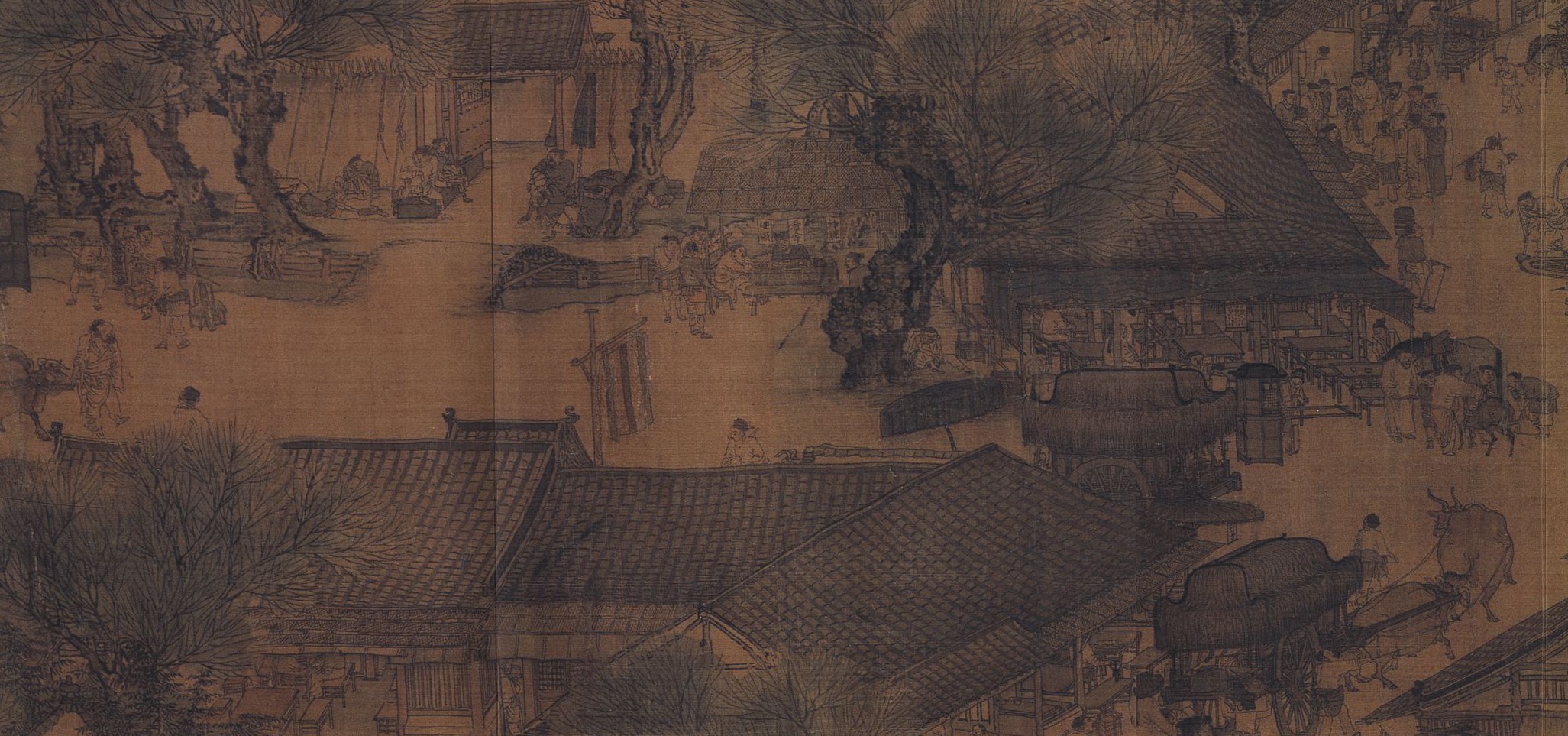
Annotation: "Here we see two types of establishments – tea houses or restaurants within a city in (twelfth century) Song China,..."
Created by: Mariko Nakajima O'neil
| Title: |
Annotation: "Here we see two types of establishments – tea houses or restaurants within a city in (twelfth century) Song China,..." |
|---|
| On Canvas: |
d06f37b7-34cb-48a8-b653-943f21268ed2 |
|---|---|
| Text: |
Here we see two types of establishments – tea houses or restaurants within a city in (twelfth century) Song China, which is known to have had a vibrant urban life thriving with trade, commerce, and entertainment.
We assume their function by the roofed buildings with aligned tables and chairs on the inside, and some people gathered around. In the upper right, we see a restaurant, or perhaps a tea house, guessing by the cups/ dishware of some sort on the outermost table. The relaxed and informal manner with which people are seated in this section, as well as the fact that two animals are being dealt with on one side, and there hunched old man seated at a tree right up at one of the tables on the other, suggests that this is a more casual establishment. The tables and benches are packed close together and even seep out past the awning onto the ‘street’. Indeed, most “diners” at this establishment are alone at their tables, which corroborates Ebrey’s description in Chinese Civilization, Chapter 41 (‘The Attractions of the Capital’): “there are special food shops such as meat-pie shops and vegetable-noodle shops, but these are not very formal, and therefore you should not invite your guests to eat there”. Furthermore, this establishment is very open to the outdoors, and is located in close proximity, if not conjoined with some stalls of the busy marketplace, where people are gathered around various goods.
By contrast, in the lower left is a building with more ornate architectural features such as a courtyard structure, a more well-defined floor, a flagpole, slitted wooden semi-walls, a more rigid thatched (rather than just cloth) awning, that seems at least slightly more secluded from the hustle and bustle of the marketplace and is enclosed by a few large trees. We can also see a few grand carriages surrounding this building, and tables are spaced more evenly, further apart. This might represent a more formal restaurant or tea house, perhaps more “suitable to elegant company”(1). Inside this building, we can just about glimpse two people sitting across one another at a table, with what looks like a third figure (maybe a server) approaching the table. The more secluded and walled nature of this building might hint that this might in fact even be what Ebrey describes as a “water teahouse” (‘pleasure houses, the tea being a cover’ (1)).
The contrast and distinction between these two different types of establishments emphasises the sophistication, and cultural nuance of Song urban life. These differences highlight that these were not businesses sprung out of pure necessity – people didn’t simply go to eat or drink here, but the cultural function and social distinction of these places were arguably just as important as the food, drink, or services they provided.
Ebrey, Chinese Civilization, ch. 41, “Attractions of the capital” |
Files