-
China Local
- Eighteen Songs
- Qingming
- Hou Wu Walkabout
- Eight-sided Hall of the Huangshan Chen family
- Headquarters of the Taiping Assistant King
- Lingxia Tang Village
- Old City of Wuyi
- Seven Pillar Hall
- Shantouxia Village
- Shanxia Bao Village
- Siping Village
- Upper Tang Village
- Yanfu Monastery
- Yao Village
- Zhuge Village
- Bailu Walkabout
- Fangyan Walkabout
- Dayuan Walkabout
- Tangxi Walkabout
- Yuyuan Walkabout
- Wenlou Walkabout
- Browse Items
- Browse Exhibits
- About
- Browse Catalogue
- Documentation
- Local History in Jinhua
- Zhiyan Village
- Lu Family
- Guodong Village
- Tianning Monastery in Jinhua
- Jinhua Prefectural City God
Annotation: "The Qingming Scroll, painted around the 1100s, depicts the city of Kaifeng during the Qingming Festival before the fall of..."
Created by: Annabel Yao
| Title: |
Annotation: "The Qingming Scroll, painted around the 1100s, depicts the city of Kaifeng during the Qingming Festival before the fall of..." |
|---|
| On Canvas: |
d06f37b7-34cb-48a8-b653-943f21268ed2 |
|---|---|
| Text: |
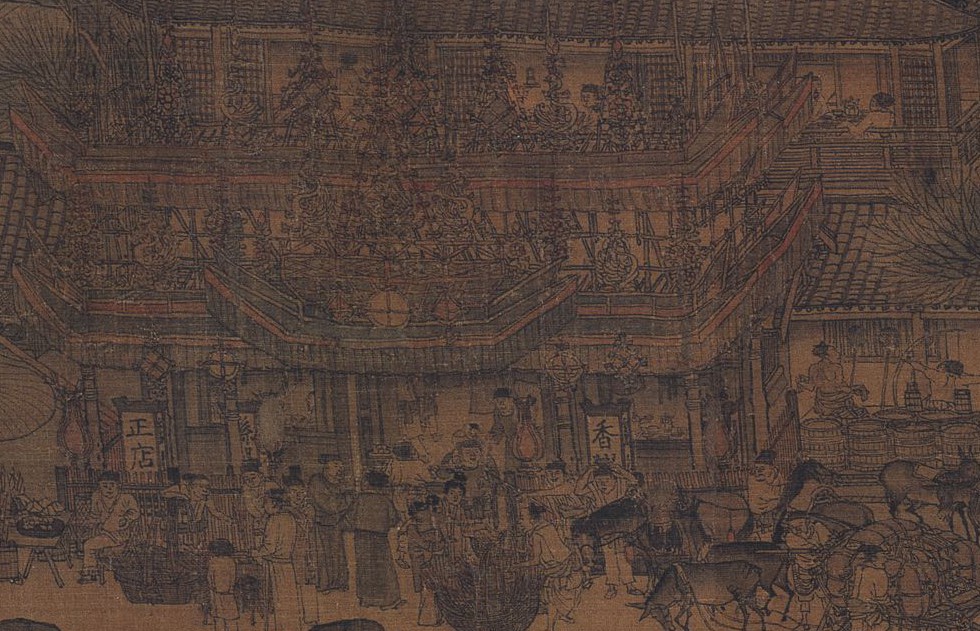
The Qingming Scroll, painted around the 1100s, depicts the city of Kaifeng during the Qingming Festival before the fall of the Northern Song dynasty in 1127. Consequently, various elements on the scroll depict scenes and factors leading to the downfall of the dynasty. Beginning from the leftmost circle, looking at the marketplace area. Everyone seems to be going about their own lives. A storefront that says “正店” is believed to be one of the main dining and entertainment areas in the city. In front of the store, what appears to be a prostitute has her arm on a man, possibly trying to seduce the man. The restaurant has several floors and faces of men and women can be seen from the windows. We can reasonably deduce that this is one of the Northern Song entertainment buildings serving food and alcohol with numerous dancing girls and prostitutes. Moving on to the next part, the city gate is busy as usual. However, there are no guards to be seen within a reasonable distance. Nor does the city wall seem to be equipped with weapons. As we know, in Ancient China, the city gate is a city’s last defense. If the city gate is guard-less and weaponless on a daily basis, isn’t it basically defenseless and conquerable without much effort? The next thing that is circled appears to be some sort of “messenger station” with several soldier-looking men sitting in front of the door. However, no one seems to be at work – everyone is either napping or lounging carelessly without dressing in proper uniform. Even the horse lounging in the yard does not seem to be in shape. This probably depicts the lack of organization and efficiency of military messaging in the late Song, which consequently led to its defeat later on. A commotion seems to be happening on the bridge in the middle of the scroll between an official on a horse, an official sitting inside a sedan chair and their respective servants. However, it appears to be that the conflict arises only because neither party is willing to let the other pass first. I personally find it quite ridiculous that the country is falling apart, but all that the officials care about is trying to boost their ego (“mianzi”).
Together, these elements depict factors that led to the downfall of the Northern Song dynasty. Moreover, by portraying the extreme contrast between the normality in people’s lives and the abnormality in how the city was running, it is depicted how oblivious people at the time were to their coming fate. Civilians were still focused on their day-to-day activities – preparing for the “keju” exam, drinking, carrying out prostitution, etc. – while corrupted officials were going about everything but their rightful duties. Through these lively illustrations, among numerous more, the painter probably sought to express his disappointment towards his country. |
Files