-
China Local
- Eighteen Songs
- Qingming
- Hou Wu Walkabout
- Eight-sided Hall of the Huangshan Chen family
- Headquarters of the Taiping Assistant King
- Lingxia Tang Village
- Old City of Wuyi
- Seven Pillar Hall
- Shantouxia Village
- Shanxia Bao Village
- Siping Village
- Upper Tang Village
- Yanfu Monastery
- Yao Village
- Zhuge Village
- Bailu Walkabout
- Fangyan Walkabout
- Dayuan Walkabout
- Tangxi Walkabout
- Yuyuan Walkabout
- Wenlou Walkabout
- Browse Items
- Browse Exhibits
- About
- Browse Catalogue
- Documentation
- Local History in Jinhua
- Zhiyan Village
- Lu Family
- Guodong Village
- Tianning Monastery in Jinhua
- Jinhua Prefectural City God
Annotation: "From cursory research, this painting was made in year 1101. The Jurchens created an official government in the year 1115,..."
Created by: Fan Zhou
| Title: |
Annotation: "From cursory research, this painting was made in year 1101. The Jurchens created an official government in the year 1115,..." |
|---|
| On Canvas: |
d06f37b7-34cb-48a8-b653-943f21268ed2 |
|---|---|
| Text: |
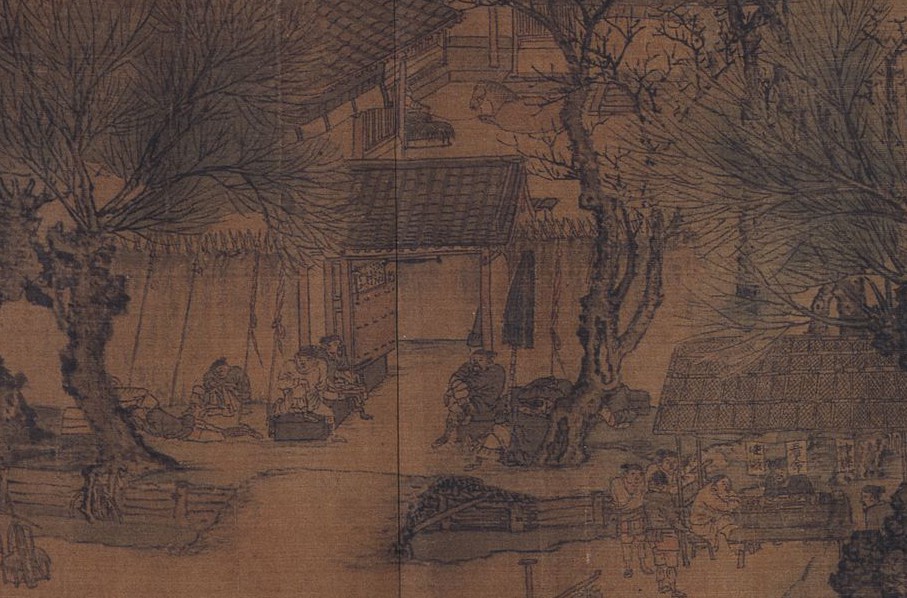
From cursory research, this painting was made in year 1101. The Jurchens created an official government in the year 1115, and the abduction of the emperors Huizong and Qinzong (known as the Shame of Jingkang) took place in year 1127. 26 years before the effective fall of the northern Song dynasty, it is already evident from this painting the military weakening of the Song state. In this small section, we can see a closed umbrella to the right of the main gate of this complex; next to it are other long sticks with tied cloth, but as it is thinner than the umbrella, we can deduce that they are flags of some sort. To the left of the gate, we can see a spear and a halberd (these ones do not have tied cloth and are not flags) as well as two flags; this combined with the rows of sharp forks on top of the walls indicates that this is a barracks, from which we can infer that the flags are battle flags. In the courtyard we can see a horse lying down resting to the right of what seems like a bingqijia, or row of weapons. In front of the gates of the barracks we can similarly see what are presumably soldiers lazing around and even napping, dressed in civilian garb (and not armour). The soldiers and horses alike are lazing about and not training, which may be a commentary on the perceived weakness of the state at the time. Indeed, a short 19 years later, in 1120 the Song struck a deal with the Jurchens in which together they defeated the Liao; but in this process, the Jurchens sensed the serious military weakness of the Song (depicted aptly in this painting), for example through their failure to conquer the southern capital of the Liao. In 1127, a short two years after the fall of Liao, this city painted here was sacked by the Jurchens and the political structure of the northern Song was effectively fallen after the emperor and his father were taken captive. All this transpired within 26 years after the painting of this scene. |
Files