-
China Local
- Eighteen Songs
- Qingming
- Hou Wu Walkabout
- Eight-sided Hall of the Huangshan Chen family
- Headquarters of the Taiping Assistant King
- Lingxia Tang Village
- Old City of Wuyi
- Seven Pillar Hall
- Shantouxia Village
- Shanxia Bao Village
- Siping Village
- Upper Tang Village
- Yanfu Monastery
- Yao Village
- Zhuge Village
- Bailu Walkabout
- Fangyan Walkabout
- Dayuan Walkabout
- Tangxi Walkabout
- Yuyuan Walkabout
- Wenlou Walkabout
- Browse Items
- Browse Exhibits
- About
- Browse Catalogue
- Documentation
- Local History in Jinhua
- Zhiyan Village
- Lu Family
- Guodong Village
- Tianning Monastery in Jinhua
- Jinhua Prefectural City God
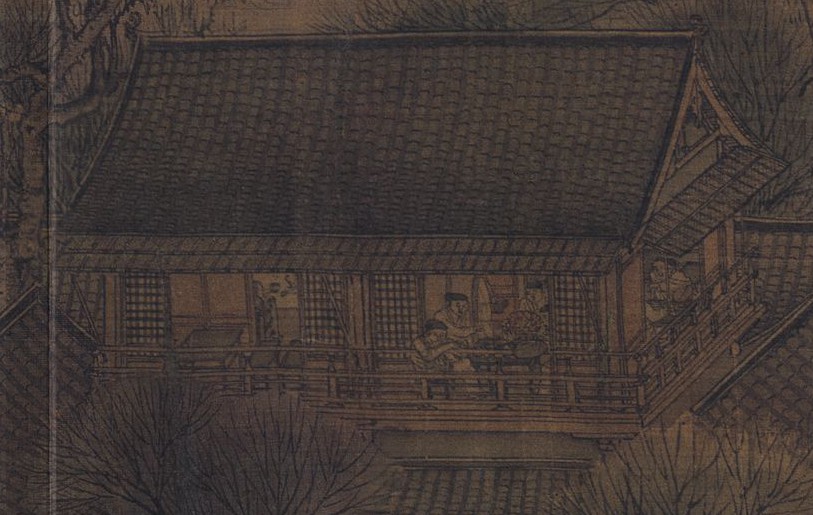
Annotation: "This scene of the Qingming scroll depicts customers enjoying the services of a traditional Chinese teahouse. Two men drink tea..."
Created by: Meimei Weston
| Title: |
Annotation: "This scene of the Qingming scroll depicts customers enjoying the services of a traditional Chinese teahouse. Two men drink tea..." |
|---|
| On Canvas: |
d06f37b7-34cb-48a8-b653-943f21268ed2 |
|---|---|
| Text: |
This scene of the Qingming scroll depicts customers enjoying the services of a traditional Chinese teahouse. Two men drink tea and socialize while a woman leans on the railing of the balcony, watching the boats float by on the river.
As noted by the primary text reading, “Attractions of the Capital”, teahouses are leisure settings where people, mostly men, come to talk, sing and play musical instruments (Ebrey). In the Song Dynasty, drinking tea was merely a way to bring people together. In the winter, warm and sometimes alcoholic substances were served at the teahouses by way of providing a means to warm the body, such as tonics and salted soybean soup (Ebrey). In the summer, plum-flower wine, sweet bean paste, cocoribe and papaya juice were offered by way of cooling down the body (ChinaTravel). Based on the lack of flower buds on trees in the rest of the painting, one can assume that the scenes in the scroll take place during winter or early spring. Therefore, we can also assume that the customers are drinking tea with tonics, possibly along with salted soybean soup.
As there are not many customers in the teahouse, we can assume that the painting takes place during the morning, a slow time for business. Otherwise, we might see men singing, playing instruments and “getting posted”, which means giving amateur performances (Ebrey). There are many different types of teahouses. There are “social teahouses”, where people gather for social settings; “trade heads”, where people conduct business, and “water teahouses”, which are pleasure houses (Ebrey).
The scene of the annotated teahouse depicted on the scroll brings light to the sexism ingrained in Chinese culture during the Song Dynasty. Firstly, the primary customers of teahouses were male. We can see this in the annotated scene as seven of the eight customers in the teahouse are male. The lack of female customers may be due to the fact that females were expected to stay at home, do chores and provide sex (FollowCN). Additionally, the woman at the teahouse is removed from the conversation with her two male companions. She is probably not there based on her own right to discuss a business deal or socialize, as men did in teahouses. Furthermore, teahouses often catered to the sexual appetites of men. For instance, water teahouses were places where gigolos and pimps socialized (Ebrey). If unaccompanied by a man, the environment could be dangerous for a woman (Whitaker, J.). This is why it is likely that the woman is a mistress, prostitute or concubine- the guest of one of the men. |
Files