-
China Local
- Eighteen Songs
- Qingming
- Hou Wu Walkabout
- Eight-sided Hall of the Huangshan Chen family
- Headquarters of the Taiping Assistant King
- Lingxia Tang Village
- Old City of Wuyi
- Seven Pillar Hall
- Shantouxia Village
- Shanxia Bao Village
- Siping Village
- Upper Tang Village
- Yanfu Monastery
- Yao Village
- Zhuge Village
- Bailu Walkabout
- Fangyan Walkabout
- Dayuan Walkabout
- Tangxi Walkabout
- Yuyuan Walkabout
- Wenlou Walkabout
- Browse Items
- Browse Exhibits
- About
- Browse Catalogue
- Documentation
- Local History in Jinhua
- Zhiyan Village
- Lu Family
- Guodong Village
- Tianning Monastery in Jinhua
- Jinhua Prefectural City God
Annotation: "The sexualization of women is also seen in other industries depicted in the Qing ming scroll. For example, the “luxuriant..."
Created by: Meimei Weston
| Title: |
Annotation: "The sexualization of women is also seen in other industries depicted in the Qing ming scroll. For example, the “luxuriant..." |
|---|
| On Canvas: |
d06f37b7-34cb-48a8-b653-943f21268ed2 |
|---|---|
| Text: |
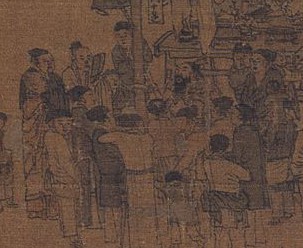
The sexualization of women is also seen in other industries depicted in the Qing ming scroll. For example, the “luxuriant inns” are institutions that house prostitutes (Ebrey). The growing prosperity of elite families in the Song Dynasty fueled the growth in numbers of concubines and prostitutes (FollowCN). The proximity of the group of women to the inn, depicted in the scroll, suggests that this may be a “luxuriant inn”. |
Files