-
China Local
- Eighteen Songs
- Qingming
- Hou Wu Walkabout
- Eight-sided Hall of the Huangshan Chen family
- Headquarters of the Taiping Assistant King
- Lingxia Tang Village
- Old City of Wuyi
- Seven Pillar Hall
- Shantouxia Village
- Shanxia Bao Village
- Siping Village
- Upper Tang Village
- Yanfu Monastery
- Yao Village
- Zhuge Village
- Bailu Walkabout
- Fangyan Walkabout
- Dayuan Walkabout
- Tangxi Walkabout
- Yuyuan Walkabout
- Wenlou Walkabout
- Browse Items
- Browse Exhibits
- About
- Browse Catalogue
- Documentation
- Local History in Jinhua
- Zhiyan Village
- Lu Family
- Guodong Village
- Tianning Monastery in Jinhua
- Jinhua Prefectural City God
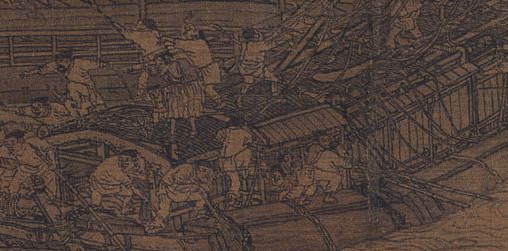
Annotation: " The most striking element of the Qingming scroll is likely that of its central scene — the crowded ship..."
Created by: Jasper Fu
| Title: |
Annotation: " The most striking element of the Qingming scroll is likely that of its central scene — the crowded ship..." |
|---|
| On Canvas: |
d06f37b7-34cb-48a8-b653-943f21268ed2 |
|---|---|
| Text: |
The most striking element of the Qingming scroll is likely that of its central scene — the crowded ship that seems set to crash into the equally crowded rainbow bridge. Many sailors seem to be using some type of barge poles in (likely futile) attempt to direct the ship away from the bridge, while at least one other is raising his pole to point at the bridge, in perhaps a similar effort to avoid collision. The identity of the bridge depends on the contested identity of the city: some scholars contend that the Qingming depicts a historical Kaifeng, and at least one specifically identifies the bridge as being “the one closest to the interior wall” (Yang Xin in Hansen 1996: 189), while others claim that the Qingming scroll simply represents an idealized, fictional city, noting the “perfect spacing of these [three] scenes”: the outskirts of the city, the canal, and the interior, with the bridge perfectly “bisect[ing] the middle third,” in a depiction that Hansen argues is too cleanly constructed to be an organic, extant city. This is further supported by the fact that the bridge itself does not necessarily map to any of the fourteen bridges in Kaifeng, without missing out on some walls or other missing features. This fictionalized argument as to the identity of the Qingming scroll also is supported by the dramatization of this impending collision. The masts of the boat are clearly far too high to ever pass safely under the bridge, and the pedestrians on the bridge, along with several beasts of burden and numerous people seemingly hanging off the edge of the bridge for a better view, appear more concerned with watching the impending collision than fleeing or even watching from a safer vantage point. Comparing the boat to one further down the river and past the bridge, suggests that the mast might be able to collapse, which would allow the boat to pass safely, but the fact that the boat had gotten so close the bridge without fully collapsing its mast and rigging without stopping, when it was clearly visible from much further away, seems again to be a result of dramatization, depicting an event (a boat that fails to collapse its mast and thus cannot fit underneath a bridge) but exaggerated to some spectacular extreme. |
Files