-
China Local
- Eighteen Songs
- Qingming
- Hou Wu Walkabout
- Eight-sided Hall of the Huangshan Chen family
- Headquarters of the Taiping Assistant King
- Lingxia Tang Village
- Old City of Wuyi
- Seven Pillar Hall
- Shantouxia Village
- Shanxia Bao Village
- Siping Village
- Upper Tang Village
- Yanfu Monastery
- Yao Village
- Zhuge Village
- Bailu Walkabout
- Fangyan Walkabout
- Dayuan Walkabout
- Tangxi Walkabout
- Yuyuan Walkabout
- Wenlou Walkabout
- Browse Items
- Browse Exhibits
- About
- Browse Catalogue
- Documentation
- Local History in Jinhua
- Zhiyan Village
- Lu Family
- Guodong Village
- Tianning Monastery in Jinhua
- Jinhua Prefectural City God
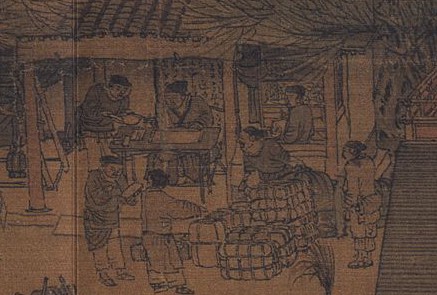
Annotation: "Municipal tax office and tax collectors: Inspectors examine goods by the city gates. One tax collector seems to be assessing..."
Created by: Chris Vassallo
| Title: |
Annotation: "Municipal tax office and tax collectors: Inspectors examine goods by the city gates. One tax collector seems to be assessing..." |
|---|
| On Canvas: |
d06f37b7-34cb-48a8-b653-943f21268ed2 |
|---|---|
| Text: |
Municipal tax office and tax collectors: Inspectors examine goods by the city gates. One tax collector seems to be assessing the contents of a merchant’s wares. Another looks to be cross-referencing the list of items with a larger list of items. That document might include the rates of taxation.
Taxation was a central feature of Northern Song commerce. William Guanglin Lui in The Chinese Market Economy 1000-1500 calculates that “the annual tax income collected by the Kaifeng municipal tax office could be used to support nearly 4,000 soldiers to guard the capital or nearly 6,000 soldiers at a local place” (3). This is a good metric by which to measure tax revenue because it shows how the political legitimacy and municipal order that the soldiers represent was underwritten by a successful market economy. State security – which protected the flourishing city depicted on the scroll – relied on taxation.
Taxation was also a central feature of diplomacy. F.W. Mote’s Imperial China explains how the Northern Song maintained a gift giving relationship with the Liao. The Northern Song sent lavish annual gifts. What would the Song get in return? The revenue from taxation – of the sort this scroll depicts – was their payment in return. “The profits on the annual trade with the Liao alone ‘were more than enough to offset those gift payments,’” Mote explains (118). The proceeds of taxation were therefore an essential source of diplomatic security, as well as a way to balance the tributary relationship with the Liao.
Another important feature of the tax office is the group of literate elites who staff it. These four or five men are all civil servants who staffed the Northern Song bureaucracy. Ebrey’s “Attractions of the Capital” notes the different taxation categories applied to businesses, merchants, and commercial arrangements according to their size (179). Performing the calculations necessary to distinguish among these required a well-trained and educated elite. They have all passed the civil servant exam and the dating of the scroll indicates that these literate elite would have been working to implement the reforms of Wang Anshi, the principal adviser to the emperor in the years prior to the painting of this scroll. According to Mote, Wang proposed important taxation reforms with the goal of eliminating tax evasion and improving efficiency. The goals of his reforms were “enriching the state and strengthening the military,” which once more revealed the linkage between taxation and a strong military (Mote, 140).
Overall, in some ways, it is fair to claim that the tax office is the most important single item depicted on this scroll because it simultaneously underpinned the Northern Song’s military, diplomacy, and market economy.
-Chris Vassallo |
Files