-
China Local
- Eighteen Songs
- Qingming
- Hou Wu Walkabout
- Eight-sided Hall of the Huangshan Chen family
- Headquarters of the Taiping Assistant King
- Lingxia Tang Village
- Old City of Wuyi
- Seven Pillar Hall
- Shantouxia Village
- Shanxia Bao Village
- Siping Village
- Upper Tang Village
- Yanfu Monastery
- Yao Village
- Zhuge Village
- Bailu Walkabout
- Fangyan Walkabout
- Dayuan Walkabout
- Tangxi Walkabout
- Yuyuan Walkabout
- Wenlou Walkabout
- Browse Items
- Browse Exhibits
- About
- Browse Catalogue
- Documentation
- Local History in Jinhua
- Zhiyan Village
- Lu Family
- Guodong Village
- Tianning Monastery in Jinhua
- Jinhua Prefectural City God
Annotation: "Max Guo
Professor Michael Szonyi
Chinese History 113
5 March 2020
Qingming Scroll Annotation
The Qingming scroll is a famous artistic masterpiece created in the..."
Created by: Max Yangfan Guo
| Title: |
Annotation: "Max Guo |
|---|
| On Canvas: |
d06f37b7-34cb-48a8-b653-943f21268ed2 |
|---|---|
| Text: |
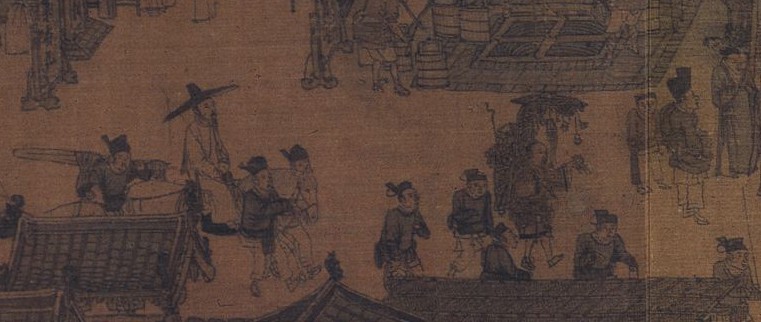
Max Guo Professor Michael Szonyi Chinese History 113 5 March 2020 Qingming Scroll Annotation The Qingming scroll is a famous artistic masterpiece created in the twelfth century Song Dynasty. Scholars disagree as to whether the depicted city and commotion in the scroll reflects any real city during the time, with suggestions that vary from the capital Kaifeng to an idealized city of the time (Qingming). Nevertheless, the scroll provides insight into the various day to day interactions that occur in a busy city in the Song Dynasty. The artist of the scroll is surprisingly unknown (Hansen 3). As one cannot deduce any peculiarities associated with the artist’s inherent bias, so the focus will be on the details of the scroll (of which there are many, as the scroll is over five meters long!). There is a region of the scroll on the very left, relatively centered in height, in which different groups of people in the Song dynasty are shown in close proximity. In particular, we call attention to two different characters in this region: a peddler selling a multitude of small objects, and, to the left of the peddler, an official riding a horse. The peddler clearly represents one of the lower classes, whereas the official is of higher class. In Ebrey’s Attractions of the Capital, such persons are characterized as “hustlers”, or people that failed to achieve high literary skill or distinction in any art. Certain qualities of the peddler are also representative: he is wearing shorts and his sleeves are relatively short and do not come up to his wrist. This is similar to the two people at the front of the official’s horse, likely of lower classes, who are also dressed in plainer, shorter clothing. Contrast this to the official himself, who is sitting calm and composed in a long robe - it is not even clear that his feet or hands are showing. This fits well in the context of the time period when scholarly and elite men wore “looser and flowier clothing” (History of Dress). An interesting observation regarding these two characters in the Qingming scroll is how close they are to each other. As a theory, perhaps it is the case that these different styles of travel and clothing serve as outward signals to distinguish the rich and wealthy from the lower classes. Otherwise, there would be no indication to the public that one is among the elite, especially if the people all mingle together in the public areas. This is in contrast to modern society, where, except for extreme circumstances, middle/lower classes and upper classes dress roughly similarly. As a whole, the Qingming scroll displays hundreds of persons and a snapshot of their daily interactions. While the two persons analyzed here represent just a small subset of the total population in the art, they already reveal a number of generalizable statements about class systems in the Song dynasty as a whole.
Works Cited “China: History of Dress.” Encyclopedia of Clothing and Fashion, Encyclopedia.com, 14 Feb. 2020, www.encyclopedia.com/fashion/encyclopedias-almanacs-transcripts-and-maps/china-history-dress. Ebrey, Patricia Buckley., and Patricia Buckley. Ebrey. Chinese Civilization: a Sourcebook, 2nd Ed. Free Press, 1993. Hansen, Valerie. The Beijing Qingming Scroll and Its Significance for the Study of Chinese History. Journal of Sung-Yuan Studies, 1996. “The Qingming Scroll.” East Asian Languages and Civilizations, ealc.fas.harvard.edu/qingming-scroll.
|
Files